The AI-Native Startup: What Business Operations Look Like When AI Agents Are Built In From Day One
Most startups hire their way through chaos. A lead falls through the cracks, hire a sales rep. Support tickets pile up, hire an agent. The ops team is drowning, hire a coordinator. And somewhere along the way, someone bolts on a AI tool here, an automation there, and calls it "digital transformation."
But there's a different way to build a business. One where AI isn't patched in as a fix. It's the foundation.
The AI-native startup doesn't add AI to existing processes. It builds every process around AI agents from day one. The result? A lean team that operates like a company three times its size, moves faster than incumbents, and scales revenue without scaling headcount.
Here's what that actually looks like in practice.
The Old Model vs. The AI-Native Model
The old model looks like this: a startup grows, accumulates tools, and eventually has a CRM that doesn't talk to the support desk, a marketing platform disconnected from sales data, and a customer success team manually scrolling through dashboards trying to spot churn risk. AI tools get added as isolated point solutions, a chatbot here, an email assistant there, but they operate in silos. The team still holds everything together.
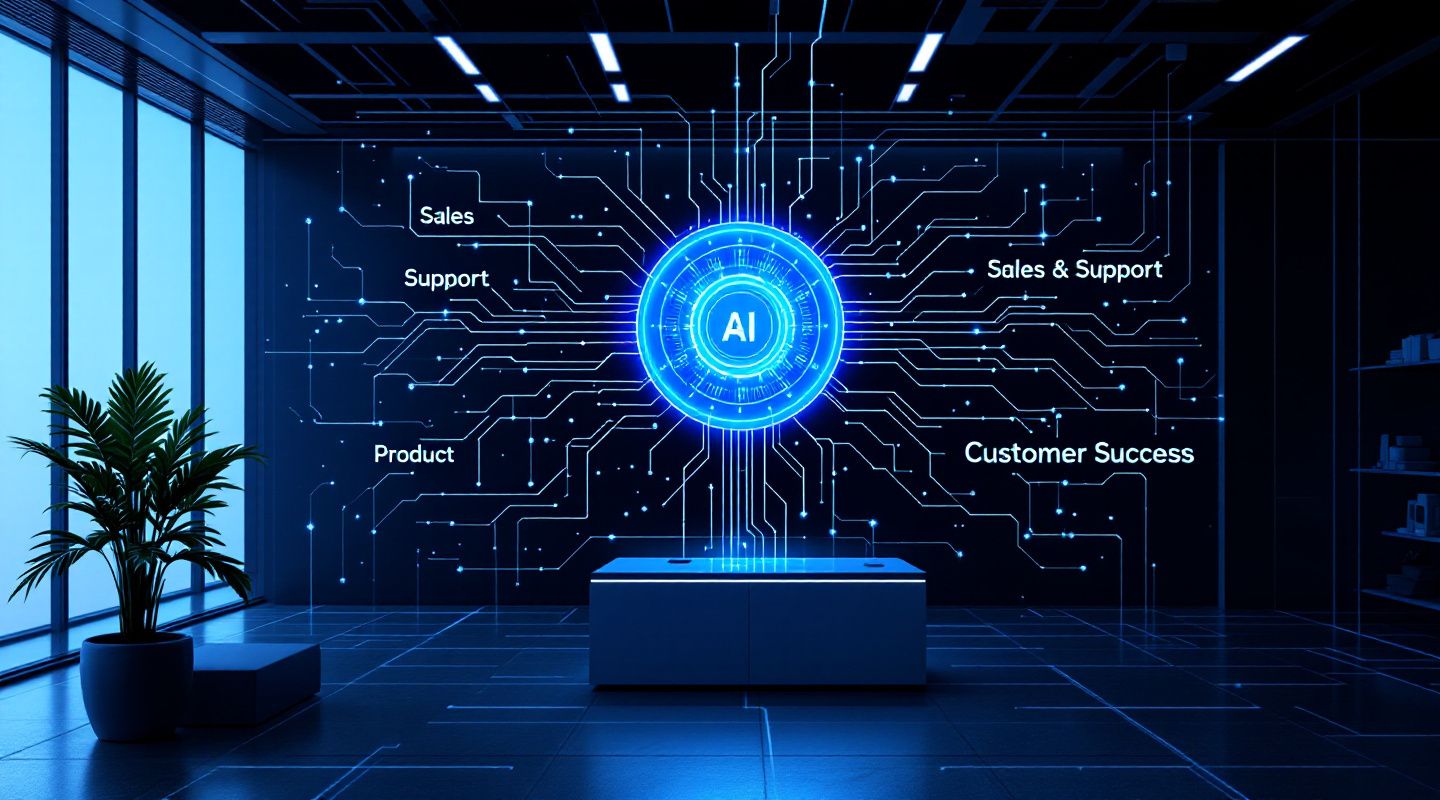
The AI-native model inverts this entirely. Instead of humans being the connective tissue between systems, AI agents are. Every core business function, sales, support, operations, product, customer success, has AI embedded directly into it. The humans set strategy, make judgment calls, and build relationships. The agents handle everything else.
This isn't a distant vision. It's operational today for startups willing to build it in from the start.
What AI-Native Operations Look Like Across Every Function
Sales: Your Pipeline Runs Itself
In an AI-native sales operation, leads don't sit in a queue waiting for a rep to get to them. An AI agent qualifies inbound leads the moment they arrive, scores them against your ICP, runs personalized outreach sequences, and books meetings directly into your calendar, all without human intervention.
The sales team wakes up to a full calendar of pre-qualified conversations, not a cold list of contacts to work through.
With Anablock's AI-first CRM, Ana, the embedded AI co-pilot, operates across your contacts, pipeline, outreach, and analytics in real time. She doesn't just log data; she acts on it. Ana surfaces the right leads at the right time, drafts follow-up messages, flags deal risk, and gives your team the intelligence to close faster with less manual work.
The impact: smaller sales teams close more pipeline because AI handles every repetitive touchpoint in the funnel.
Support: Always On, Always Accurate
Customer support is one of the first functions that breaks as a company scales. Tickets multiply, response times slip, and customers notice.
An AI-native support model deploys AI as the first line of response, not a frustrating FAQ bot, but a genuinely capable agent that resolves common questions, handles account inquiries, processes requests, and only escalates to a human when complexity or emotion demands it.
Echo, Anablock's AI voice and text agent, is built exactly for this. Echo handles customer-facing interactions across voice and text channels 24/7, with the context and tone of a trained support professional. Customers get instant, accurate responses at any hour. Your human team focuses only on the conversations that truly need them.
The result is a support operation that scales with your customer base, without scaling your headcount.
Operations: The Invisible Workforce
Every business has a layer of invisible work: scheduling, data entry, internal reporting, document processing, workflow routing. In a traditional startup, this work quietly consumes hours from people who should be doing higher-leverage work.
In an AI-native operation, these tasks are handled by agents running in the background. Internal workflows trigger automatically. Data moves between systems without manual intervention. Reports surface themselves. Scheduling coordinates itself.
A lean team of ten can operate with the administrative output of thirty when AI agents handle the operational substrate. This is what allows AI-native startups to stay lean while growing fast. They never hire for volume, only for judgment.
Product: Faster Cycles, Smarter Roadmaps
Product development in an AI-native company doesn't just use AI for coding assistance (though it does that too). It uses AI to close the feedback loop between customers and the roadmap automatically.
AI agents monitor support conversations, analyze usage patterns, and synthesize customer feedback into structured product signals, flagging what's breaking, what's confusing, what customers keep asking for. Product teams get a continuously updated intelligence feed instead of a quarterly survey.
The compounding effect: faster iteration cycles, fewer misaligned features, and a product that gets genuinely better in response to real user behavior, not assumptions.
Customer Success: Proactive, Not Reactive
Traditional customer success is reactive. A customer goes quiet, usage drops, and by the time someone notices, the relationship is already at risk.
AI-native customer success flips the script. AI agents monitor usage patterns continuously, flag early churn signals, and trigger proactive outreach before the customer ever has to raise their hand. A health score dips, an AI-drafted check-in goes out. Usage of a key feature drops, an educational sequence kicks off automatically.
When integrated with Ana in the CRM, these signals flow directly into pipeline views, giving customer success teams and sales teams a shared, real-time picture of account health. No more spreadsheets. No more manual check-ins that fall through the cracks.
Why This Matters Now
The competitive dynamics of the next decade will be shaped by which companies figured out how to do more with less, not by who hired the most people. AI-native startups have a structural advantage: they scale revenue and customer relationships without proportionally scaling cost.
But this advantage is only accessible to companies that build AI in from the beginning, or deliberately convert their operations to an AI-native model before the inefficiencies compound.
Bolting AI onto a legacy process is like installing a modern engine into a horse-drawn carriage. The real leverage comes from designing the vehicle around the engine.
Build AI-Native From Day One
If you're a founder or operator building a new company, or rebuilding how an existing one runs, the decisions you make right now about your operational architecture will determine your ceiling for the next five years.
Anablock's AI-first CRM with Ana as your embedded AI co-pilot, and Echo as your customer-facing AI agent, are the infrastructure layer for the AI-native business. They're not tools you add to your stack. They're the operating model.
Ready to build or convert your business into an AI-native operation?
Book a call with our team and we'll map out exactly what an AI-native architecture looks like for your specific business: your sales motion, your support volume, your team structure, your growth stage.
Book your call here → https://crm.anablock.com/book/vuk/meet-with-vuk
The companies building AI-native today are the ones that will look inevitable in three years. Don't let your competitors figure this out first.