
October 23, 2026
A practical guide for founders and small teams on building a simple, AI assisted support system without hiring a dedicated support department.
Anablock is a technology and AI systems company helping businesses automate workflows, connect tools, improve lead handling, and build smarter digital growth systems. The Anablock team writes about AI implementation, automation, CRM, lead generation, SEO/AEO, and practical ways businesses can use technology to operate better and grow.
March 2026 | Enterprise AI | Decision Framework
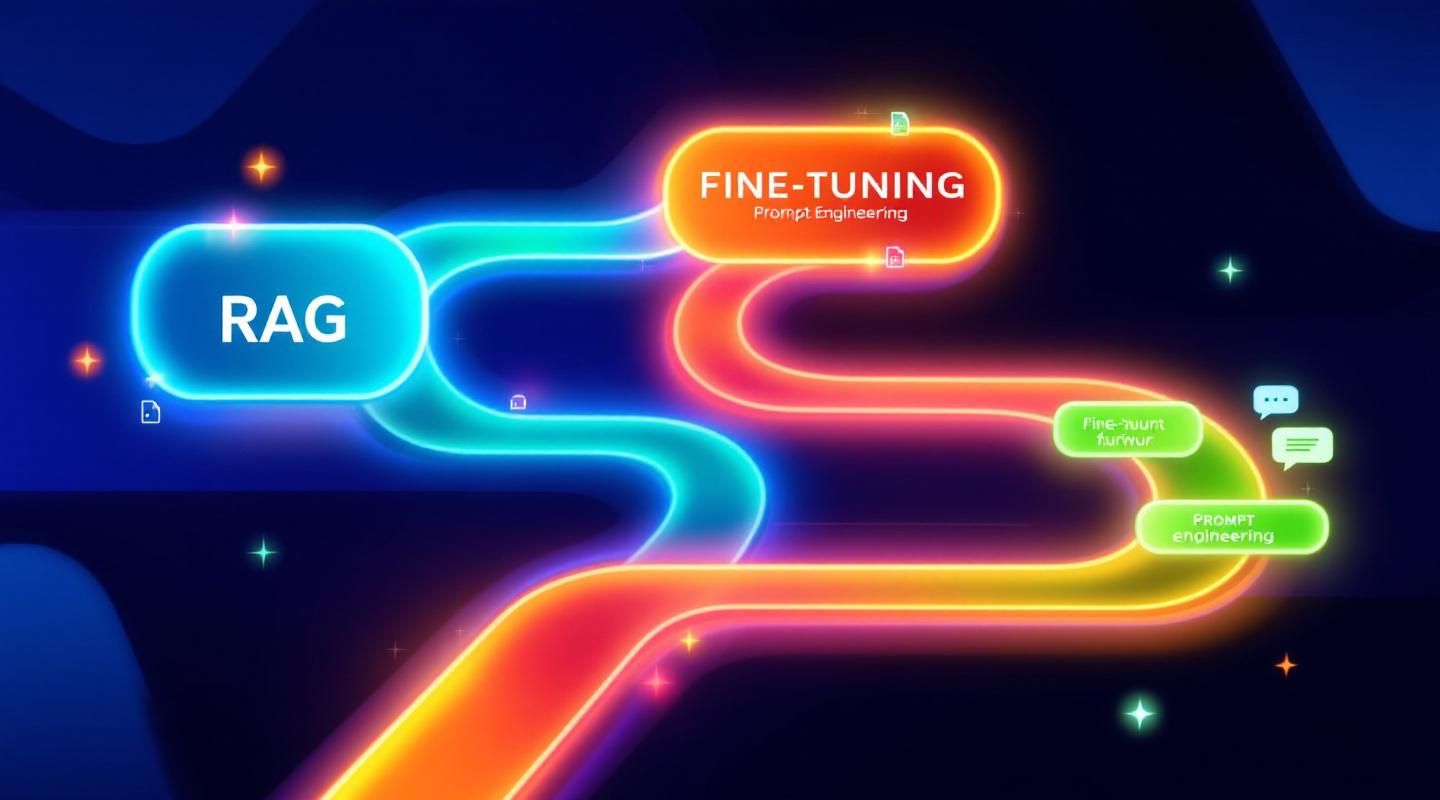
Every enterprise AI project eventually hits the same fork in the road: RAG, fine-tuning, or prompt engineering?
Vendors have strong opinions — usually aligned with whatever they're selling. RAG vendors will tell you fine-tuning is expensive and stale. Fine-tuning vendors will tell you RAG is slow and complex. Prompt engineering consultants will tell you both are overkill.
The honest answer is that each approach has genuine strengths, genuine weaknesses, and a specific set of use cases where it outperforms the others. The right choice depends on your data, your use case, your budget, and your tolerance for complexity.
This is the vendor-neutral breakdown.
Prompt engineering is the practice of crafting inputs to an LLM to guide its outputs—adjusting tone, format, reasoning style, and constraints through the text you send to the model. No model weights are changed. No external data is retrieved. You're working entirely within the model's existing knowledge.
What it's good for: Defining behavior (tone, format, persona), simple Q&A on topics the model already knows well, rapid prototyping, content generation tasks where factual precision is less critical.
What it's not good for: Anything requiring knowledge the model wasn't trained on, anything requiring up-to-date information, anything where you need to cite sources.
RAG connects an LLM to an external knowledge base. At query time, the system retrieves the most relevant documents from your knowledge base, then passes them to the LLM as context for generating a response. The model's weights don't change — but its knowledge does, dynamically, with every query.
What it's good for: Applications requiring current or private data (customer support, compliance Q&A, document search), use cases where source citations matter, knowledge bases that change frequently.
What it's not good for: Applications requiring sub-50ms response times (retrieval adds latency), tasks requiring highly consistent stylistic output, very high-volume applications where retrieval costs compound.
Fine-tuning retrains a pre-trained model on your domain-specific data, adjusting the model's weights to improve performance on specific tasks. The model "learns" your domain, your terminology, your style — and can apply that knowledge without needing to retrieve it at query time.
What it's good for: Narrow, well-defined tasks requiring consistent behaviour (specific output formats, domain-specific reasoning patterns), very high-volume applications where per-query cost matters, applications requiring sub-50ms latency.
What it's not good for: Dynamic data (the model's knowledge is frozen at training time), use cases where you need source citations, situations where your data changes frequently.
Cost is where vendor claims diverge most dramatically from reality. Here's what the numbers actually look like:
| Approach | Upfront Setup Cost | Time to Deploy |
|---|---|---|
| Prompt Engineering | Near zero | Hours to days |
| RAG | $4,000–$30,000 | 2–4 weeks |
| Fine-Tuning | $2,400–$50,000+ | 3–8 weeks |
| RAG + Fine-Tuning (hybrid) | $20,000–$80,000+ | 6–12 weeks |
RAG setup costs include vector database infrastructure, data ingestion pipelines, embedding model costs, and engineering time. Fine-tuning costs include data preparation (often the most expensive part), compute for training runs, and evaluation.
| Approach | Cost per 1,000 Queries | Notes |
|---|---|---|
| Base LLM only | ~$11 | No retrieval, no fine-tuning |
| Prompt Engineering | ~$11–15 | Slightly higher due to longer prompts |
| RAG | ~$41 | Retrieval + longer context windows |
| Fine-Tuned model | ~$20 | Lower per-query, but retraining costs |
| RAG + Fine-Tuned (hybrid) | ~$49 | Highest accuracy, highest cost |
The crossover point: At low query volumes (under ~1M queries/month), RAG is almost always cheaper than fine-tuning when you factor in setup and maintenance. At very high volumes (10M+ queries/month), fine-tuning's lower per-query cost can offset its higher setup cost.
For a typical enterprise deployment:
Latency is the other major trade-off that vendors understate:
| Approach | Typical Latency | Notes |
|---|---|---|
| Prompt Engineering | 200–800ms | LLM inference only |
| RAG | 300ms–2,500ms | Retrieval adds 100ms–2s overhead |
| Fine-Tuning | 50–200ms | No retrieval; faster inference |
RAG's retrieval overhead is real and matters for user-facing applications. A customer support chatbot with 2-second response times will frustrate users. A compliance Q&A tool used by analysts may tolerate it.
The latency gap can be reduced with optimised vector databases, caching, and hybrid retrieval strategies — but it cannot be eliminated entirely. If your application requires sub-100ms responses, fine-tuning is likely the better architectural choice.
This is where fine-tuning's fundamental limitation becomes most apparent:
Fine-tuned models are frozen at training time. If your regulatory environment changes, your product catalogue updates, or your policies evolve, your fine-tuned model doesn't know. You have to retrain — at a cost of $500–$5,000 per retraining cycle, plus the time and engineering overhead.
RAG knowledge bases update in real time. Add a new document, update a policy, change a price — the system reflects it immediately, at zero additional cost.
For any application where the underlying knowledge changes more than quarterly, RAG's update economics are dramatically better than fine-tuning's.
Prompt engineering is genuinely powerful for rapid iteration and for tasks where the model's existing knowledge is sufficient. It's also genuinely fragile at scale — small changes in prompt wording can produce dramatically different outputs, and there's no systematic way to ensure consistency across thousands of queries.
For production enterprise applications requiring reliability and consistency, prompt engineering alone is rarely sufficient. It's best used as a complement to RAG or fine-tuning, not as a standalone approach.
RAG has become the enterprise default for knowledge-intensive applications for good reasons: it's cheaper to set up than fine-tuning, it handles dynamic data naturally, it provides source citations, and it can be deployed in weeks rather than months.
The honest caveats: RAG is only as good as your knowledge base. Poorly structured, inconsistently formatted, or incomplete documents will produce poor retrieval — and poor retrieval produces poor answers regardless of how good the LLM is. The "index everything and it works" promise understates the data preparation work required.
RAG also adds latency and cost at scale. For very high-volume, latency-sensitive applications, the economics eventually favour fine-tuning.
Fine-tuning is genuinely powerful for narrow, well-defined tasks with stable knowledge. It's also genuinely expensive, time-consuming, and brittle when the underlying domain changes.
The most common mistake in enterprise AI is reaching for fine-tuning before exhausting prompt engineering and RAG. Fine-tuning should be the last resort, not the first instinct — used only when you have a specific, measurable gap that simpler approaches can't close.
For most enterprise applications in 2026, the winning combination is:
Prompt Engineering + RAG
Prompt engineering defines the behaviour (tone, format, reasoning style, safety constraints). RAG provides the knowledge (current, private, citable). Together, they cover the vast majority of enterprise knowledge-intensive use cases at reasonable cost and complexity.
Add fine-tuning only when you have a specific, measurable accuracy gap that this combination can't close — and when you have the data, budget, and engineering capacity to maintain it.
Before committing to an approach, answer these questions:
How often does your knowledge change? If frequently, RAG wins on economics. If rarely, fine-tuning becomes more viable.
What's your query volume? Under 5M/month: RAG is almost always cheaper. Over 10M/month: fine-tuning's per-query economics start to matter.
What's your latency requirement? Under 100ms: fine-tuning. Over 500ms acceptable: RAG.
Do you need source citations? Yes: RAG. No: either approach works.
How much training data do you have? Under 1,000 high-quality examples: fine-tuning is risky. Over 10,000: fine-tuning becomes viable.
What's your tolerance for maintenance? Low: RAG (updates are free). High: fine-tuning (retraining is expensive but manageable).
There is no universally correct answer. The right approach depends on your specific use case, data, budget, and constraints.
But if you're starting from scratch and don't have a specific reason to choose otherwise: start with prompt engineering to prototype, add RAG to ground your application in real knowledge, and only consider fine-tuning when you have a specific, measurable gap that the first two approaches can't close.
This sequence minimises cost, minimises time to deployment, and maximises your ability to iterate — which is almost always more valuable than optimising for a single metric before you understand your production requirements.
Sources: Enterprise RAG vs. Fine-Tuning Cost Analysis 2025–2026 | LLM Deployment Economics Report 2025 | RAGAS Framework Documentation | DeepEval Benchmarking Methodology | EU AI Act Compliance Guidelines 2026
Written by
AI Insights & Innovations
Anablock is a technology and AI systems company helping businesses automate workflows, connect tools, improve lead handling, and build smarter digital growth systems. The Anablock team writes about AI implementation, automation, CRM, lead generation, SEO/AEO, and practical ways businesses can use technology to operate better and grow.


If you are ready to move from research to implementation, we can help map the right AI system around your tools, data, team, and goals.