
August 12, 2026
How connecting Slack to your CRM closes the gap between team conversations and deal tracking — and what a real integration should actually do.
Anablock is a technology and AI systems company helping businesses automate workflows, connect tools, improve lead handling, and build smarter digital growth systems. The Anablock team writes about AI implementation, automation, CRM, lead generation, SEO/AEO, and practical ways businesses can use technology to operate better and grow.
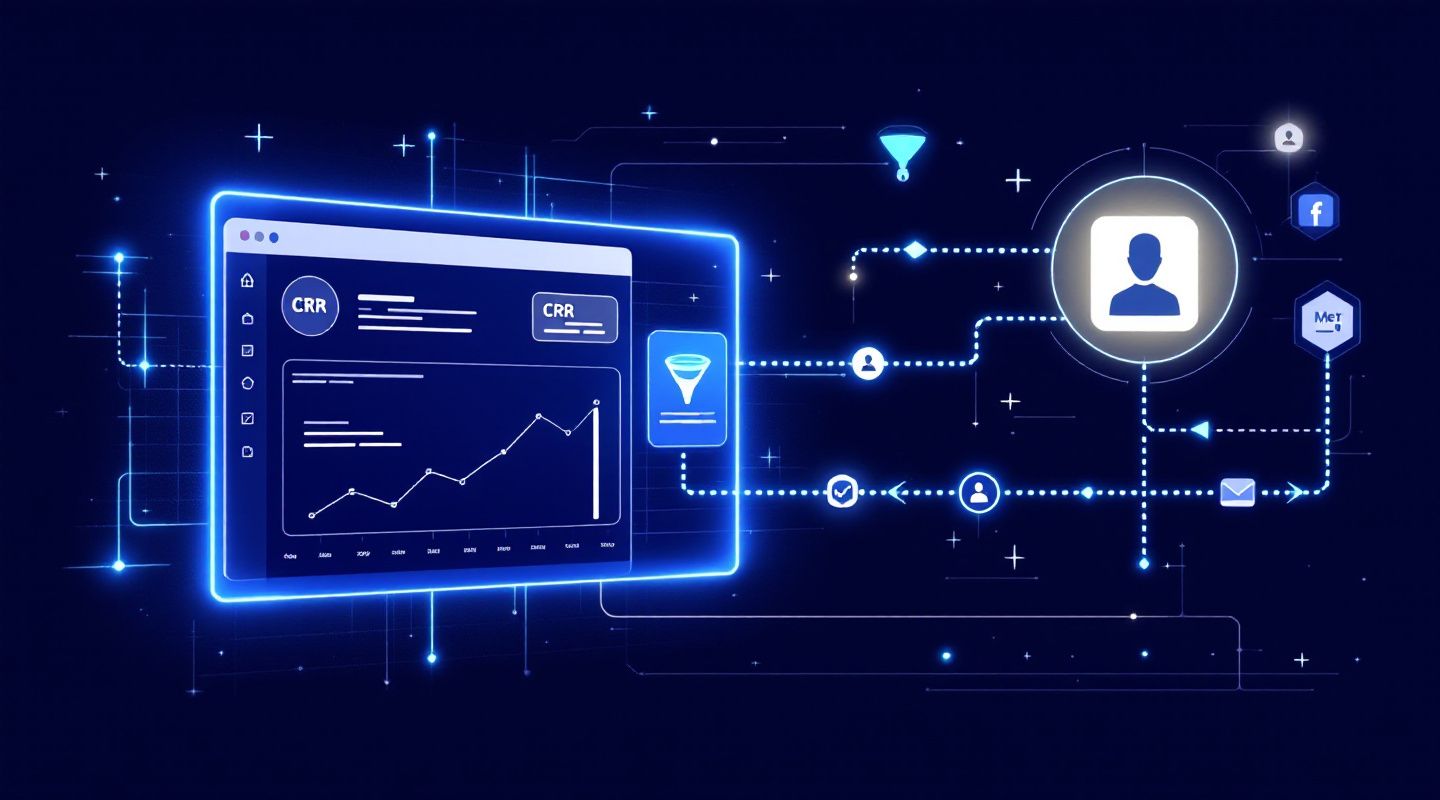
Marketing teams have gotten really good at getting people to click. Sales teams have gotten really good at closing deals. The problem is what happens in between — and for most companies, that gap is where Facebook ad spend quietly evaporates.
You launch a campaign, generate a stack of leads, and then... nothing connects. The ad platform knows who clicked. The CRM knows who eventually became a customer. Nobody knows which ad, which audience, or which creative actually drove the deal. That disconnect is the single biggest reason marketing and sales teams argue about budget every quarter.
Facebook Ads Manager is excellent at telling you cost-per-click, reach, and impressions. It is terrible at telling you whether the person who clicked ever became a paying customer. Meanwhile, your CRM knows exactly who converted — but has no idea which ad campaign, ad set, or creative brought them in unless someone manually tags it.
The result is a familiar pattern:
None of this is a tooling failure. It's an integration failure. The data exists on both sides; it just isn't talking to itself.
A proper Facebook Ads integration closes the loop in both directions:
Ad account → CRM. Every lead that comes in through a Facebook lead form or click-to-website campaign lands in the CRM automatically — pre-tagged with the campaign name, ad set, ad creative, and platform (META_ADS). No manual CSV exports, no lag between lead capture and follow-up.
CRM → ad account. Once that lead moves through the pipeline — qualified, opportunity, customer, or closed-lost — that outcome data can feed back into Facebook to build lookalike audiences from your best customers, exclude closed-lost contacts from retargeting, and calculate true cost-per-acquisition and cost-per-customer instead of cost-per-click.
That second direction is the part most teams skip, and it's the one that actually changes ROI.
1. Automatic lead attribution. When someone fills out a Facebook Lead Ad, the CRM captures not just their name and email but the full attribution chain — adPlatform, campaign, and click timestamp. Sales reps see exactly what brought a prospect in before they ever pick up the phone, which changes how the first conversation opens. "I saw you clicked on our ROI calculator ad" lands very differently than a cold "how did you hear about us?"
2. Speed-to-lead that actually matters. Facebook leads decay fast — studies on lead response time consistently show conversion odds drop sharply after the first five minutes. An integration that pushes leads into the CRM in real time (rather than a nightly batch export) is often the single biggest lever on Facebook lead conversion rate, independent of anything you do to the ad creative itself.
3. Closed-loop reporting. Instead of "we spent $12,000 and got 340 leads," the integration lets you say "we spent $12,000, got 340 leads, 41 became opportunities, and 9 closed for $94,000 in revenue." That's the number finance actually cares about, and it's the only number that should drive next quarter's ad budget.
4. Smarter audiences, built from real outcomes. Once won and lost deals are tagged in the CRM, that segmented data can inform custom and lookalike audiences on the ads side — targeting more people who resemble your actual customers, not just people who resemble your leads. Leads and customers are not the same population, and treating them that way in your targeting is a common source of wasted spend.
5. One dashboard instead of two truths. Marketing and sales stop reconciling spreadsheets in the weekly pipeline meeting because the attribution data and the deal data live in the same record.
If you're building or evaluating this kind of integration, a few things separate a good implementation from a shallow one:
adPlatform, utmCampaign, utmSource, utmMedium, and click identifiers (fbclid, fbc, fbp) stored on the contact record — not collapsed into a single generic "Facebook" tag. Granularity here is what makes the reporting useful later.Facebook Ads and your CRM are answering two halves of the same question — "did this work?" — and right now most companies can only see one half at a time. Integrating the two doesn't just save the manual work of tagging and exporting leads; it changes what you can actually optimize for. Cost-per-click is a marketing metric. Cost-per-customer is a business metric. The integration is what lets you report the second one.
Want this set up for your own ad account and CRM? Anablock builds and manages exactly this kind of integration — real-time lead sync, full attribution tracking, and closed-loop reporting between Facebook Ads and your pipeline. Talk to us about connecting your ad accounts →
Written by
AI Insights & Innovations
Anablock is a technology and AI systems company helping businesses automate workflows, connect tools, improve lead handling, and build smarter digital growth systems. The Anablock team writes about AI implementation, automation, CRM, lead generation, SEO/AEO, and practical ways businesses can use technology to operate better and grow.


If you are ready to move from research to implementation, we can help map the right AI system around your tools, data, team, and goals.